
Subjects and exams › Test Prep › AP (Advanced Placement)
AP World History: Modern
Free AP World History: Modern flashcard decks and quizzes covering all 9 units, from the Silk Roads to globalization, at Knovli.
Study AP World History: Modern freeBrowse every deck
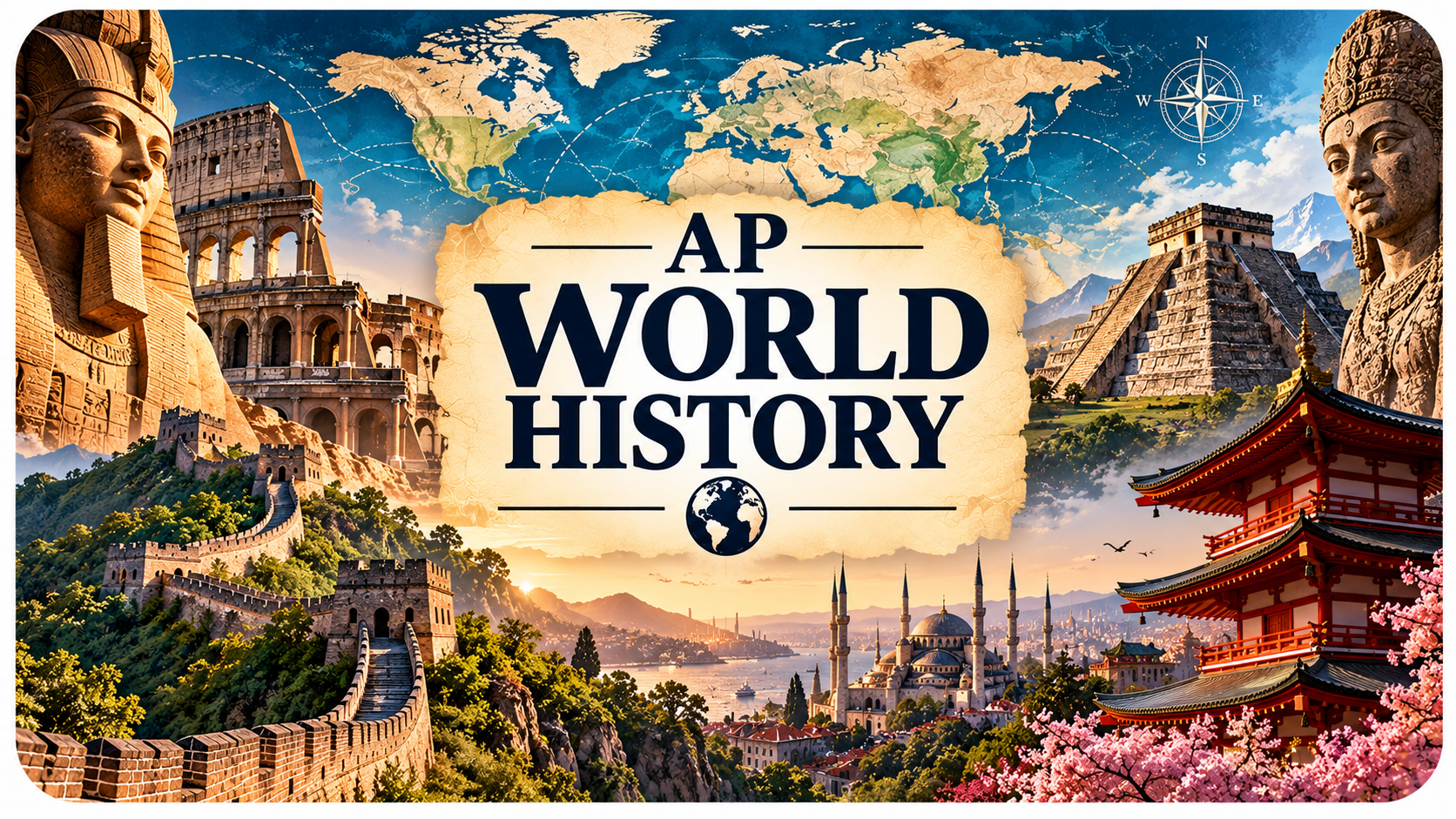
AP World History: Modern — Study Guide and Exam Prep
AP World History: Modern is one of the most popular Advanced Placement courses offered in U.S. high schools. It covers roughly 800 years of global history, from 1200 to the present day, and asks students to think analytically about how societies, economies, and cultures have changed and connected over time. The exam is taken by high school students seeking college credit, though teachers and parents often use the same materials to support classroom learning at home.
What the Course Covers
The course is organized into nine units, each tied to a specific period and theme:
- The Global Tapestry (1200–1450): States, empires, and belief systems across Asia, Europe, Africa, and the Americas. Start with the Global Tapestry flashcard deck or test yourself with the Global Tapestry quiz.
- Networks of Exchange (1200–1450): The Silk Roads, Indian Ocean network, and trans-Saharan trade. Practice with the Networks of Exchange deck or the Networks of Exchange quiz.
- Land-Based Empires (1450–1750): How gunpowder empires like the Ottomans, Mughals, and Qing consolidated power. Use the Land-Based Empires deck or the Land-Based Empires quiz.
- Transoceanic Interconnections (1450–1750): European exploration, the Columbian Exchange, and maritime empires. Try the Transoceanic Interconnections deck and the Transoceanic Interconnections quiz.
- Revolutions (1750–1900): Political revolutions, Enlightenment ideas, and industrialization. Review with the Revolutions deck or the Revolutions quiz.
- Consequences of Industrialization (1750–1900): Imperialism, labor migration, and resistance. See the Consequences of Industrialization deck and the Consequences of Industrialization quiz.
- Global Conflict (1900–1945): The World Wars, nationalism, and mass atrocities. Work through the Global Conflict deck or the Global Conflict quiz.
- Cold War and Decolonization (1900–present): Superpower rivalry and independence movements. Study with the Cold War and Decolonization deck or the Cold War and Decolonization quiz.
- Globalization (1900–present): Economic integration, technology, and environmental challenges. Use the Globalization deck or the Globalization quiz.
For official information on the exam format and scoring, check the College Board website directly.
How to Study Effectively
AP World History: Modern covers a large span of time and geography. A few habits make a real difference:
- Study a little each day. Spreading review across weeks beats cramming. Even ten minutes of flashcards the night before class helps vocabulary stick.
- Use active recall. Reading notes is passive. Testing yourself with flashcards or quizzes forces your brain to retrieve information, which builds stronger memory. Knovli's flashcard system is built around this principle.
- Move unit by unit. The nine units build on each other. Mastering the earlier periods first gives you context for understanding later ones.
- Check what you actually know. After reviewing a deck, take the matching quiz to find gaps. The quiz games on Knovli make this straightforward.
- Track your progress. Knovli's study modes and mastery plan let you see which cards you have learned and which still need work.
What Knovli Offers for AP World History: Modern
Knovli is a free study site. It provides a flashcard deck and a quiz for every unit of AP World History: Modern, all available without a subscription. You can browse all public decks or create a free account to track your mastery over time. Knovli is an independent study tool and has no affiliation with the College Board.
If you are also studying other AP courses, Knovli has material for AP U.S. History and AP U.S. Government and Politics as well.
Units
Unit 1: The Global Tapestry1 deck · 1 quiz
Examines the development of states, empires, and belief systems across Asia, Europe, Africa, and the Americas from 1200 to 1450.
- AP World History: Modern · The Global Tapestry 153 cards Made by Knovli
- AP World History: Modern · The Global Tapestry Quiz quiz 300 questions Made by Knovli
Unit 2: Networks of Exchange1 deck · 1 quiz
Covers cross-cultural trade routes including the Silk Roads, Indian Ocean network, and trans-Saharan exchange from 1200 to 1450.
- AP World History: Modern · Networks of Exchange 156 cards Made by Knovli
- AP World History: Modern · Networks of Exchange Quiz quiz 300 questions Made by Knovli
Unit 3: Land-Based Empires1 deck · 1 quiz
Analyzes how gunpowder empires such as the Ottomans, Mughals, and Qing expanded and consolidated power from 1450 to 1750.
- AP World History: Modern · Land-Based Empires 120 cards Made by Knovli
- AP World History: Modern · Land-Based Empires Quiz quiz 240 questions Made by Knovli
Unit 4: Transoceanic Interconnections1 deck · 1 quiz
Explores European exploration, the Columbian Exchange, and the growth of maritime empires between 1450 and 1750.
- AP World History: Modern · Transoceanic Interconnections 156 cards Made by Knovli
- AP World History: Modern · Transoceanic Interconnections Quiz quiz 300 questions Made by Knovli
Unit 5: Revolutions1 deck · 1 quiz
Examines political revolutions, Enlightenment ideals, industrialization, and their economic and social consequences from 1750 to 1900.
- AP World History: Modern · Revolutions 144 cards Made by Knovli
- AP World History: Modern · Revolutions Quiz quiz 300 questions Made by Knovli
Unit 6: Consequences of Industrialization1 deck · 1 quiz
Covers imperialism, labor migration, economic shifts, and resistance movements driven by industrial capitalism from 1750 to 1900.
- AP World History: Modern · Consequences of Industrialization 144 cards Made by Knovli
- AP World History: Modern · Consequences of Industrialization Quiz quiz 300 questions Made by Knovli
Unit 7: Global Conflict1 deck · 1 quiz
Analyzes the causes and effects of the World Wars, rise of nationalism, and mass atrocities from 1900 to 1945.
- AP World History: Modern · Global Conflict 144 cards Made by Knovli
- AP World History: Modern · Global Conflict Quiz quiz 300 questions Made by Knovli
Unit 8: Cold War and Decolonization1 deck · 1 quiz
Examines superpower rivalry, independence movements, and the restructuring of global politics from 1900 to the present.
- AP World History: Modern · Cold War and Decolonization 156 cards Made by Knovli
- AP World History: Modern · Cold War and Decolonization Quiz quiz 300 questions Made by Knovli
Unit 9: Globalization1 deck · 1 quiz
Explores economic integration, technological change, environmental challenges, and cultural exchange in the contemporary world.
- AP World History: Modern · Globalization 144 cards Made by Knovli
- AP World History: Modern · Globalization Quiz quiz 300 questions Made by Knovli
Knovli is an independent study tool. Exam and course names belong to their owners, who do not sponsor or endorse this page.