Spaced Practice: The Science-Backed Study Method That Makes Information Stick

By Knovli · September 23, 2026
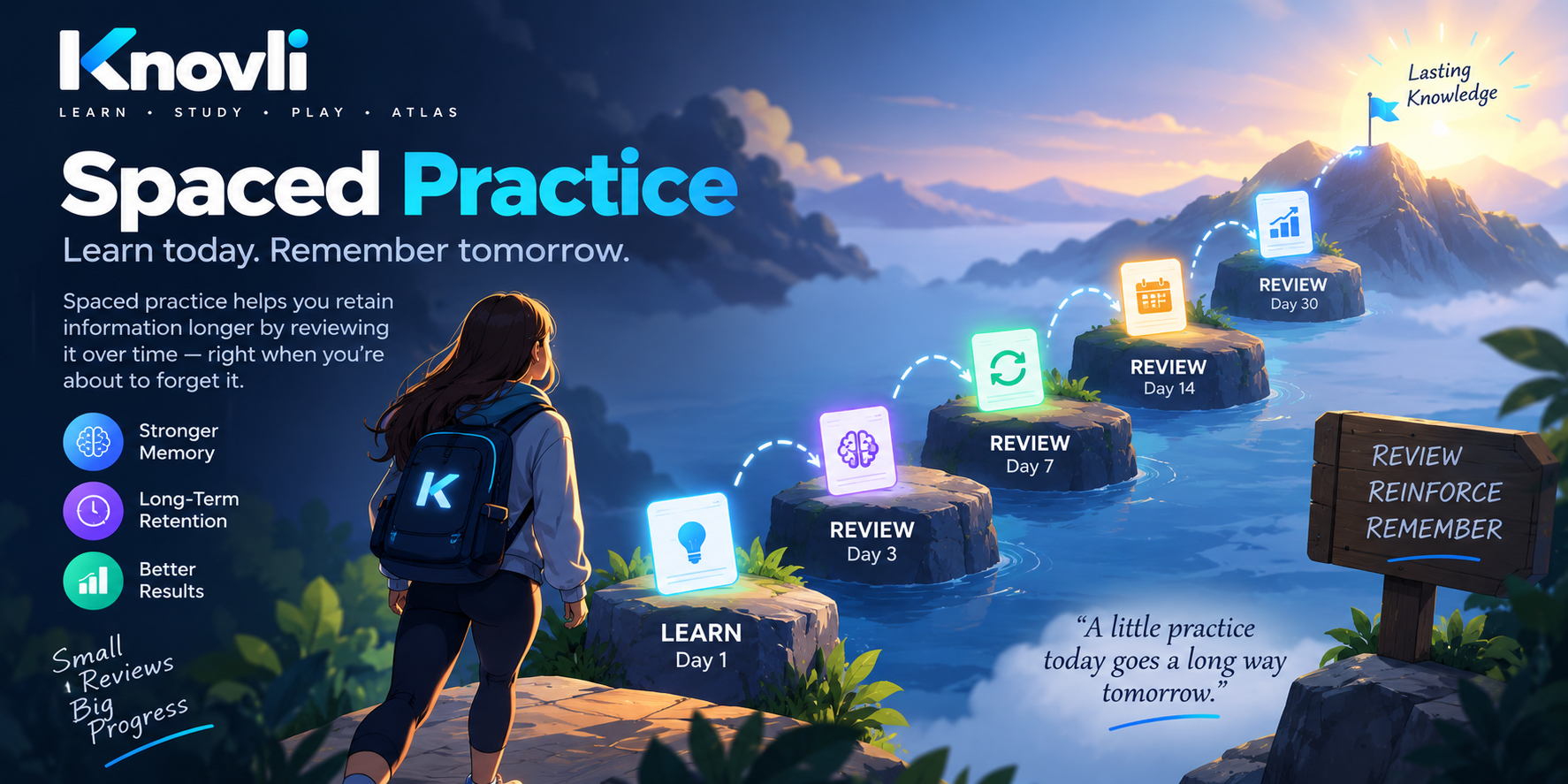
Learn how spaced practice works, why it beats cramming, and how students and teachers can use it to prepare for AP exams and beyond.
What Is Spaced Practice?
Spaced practice — also called distributed practice or the spacing effect — means spreading your study sessions across days and weeks instead of piling everything into one long cram session the night before a test. The idea is simple: review material, wait a bit, review it again, wait longer, review once more. Each time you return to something you've almost forgotten, your brain works harder to retrieve it — and that effort is exactly what makes the memory stick.
Psychologist Hermann Ebbinghaus documented the principle in the 1880s with his "forgetting curve," showing that memories fade quickly after learning but can be reinforced and strengthened with timely review. More than a century of follow-up research consistently confirms the same finding: spacing beats cramming for long-term retention.
Why Cramming Fails (Even When It Feels Like It Works)
Cramming produces a short-term spike in familiarity that students often mistake for real learning. Information crammed the night before an exam can feel solid at 8 a.m. and be largely gone by the following weekend. For a unit quiz, cramming might be enough. For an AP exam in May that covers content from September, it is not a strategy — it is a gamble.
Spaced practice forces your brain through the retrieval process repeatedly. Every retrieval attempt — especially when there is some forgetting involved — strengthens the neural pathways associated with that memory. The slight difficulty of remembering something you studied three days ago is not a sign that you studied wrong; it is the mechanism that makes the learning durable.
A Practical Spaced Practice Schedule
You do not need an elaborate system to get started. A simple interval pattern works well for most high school and college students:
- Day 1: Study new material for the first time. Use flashcards, notes, or a deck on Knovli.
- Day 2: Review the same material briefly — 10 to 15 minutes.
- Day 5: Review again. Focus extra time on anything you got wrong on Day 2.
- Day 14: Another review session. This one should feel easier, which means it is working.
- Day 30+: One final review before the exam window opens.
For AP students, this means building a review calendar at the start of the semester — not the week before the exam. If your AP U.S. History exam is in May, content from Unit 2 should appear in your schedule again in February, March, and April.
Spaced Practice in Action: AP Examples
The technique works across every subject, but it is especially powerful for content-heavy AP courses where vocabulary, court cases, dates, and concepts compound over the full year.
- AP U.S. Government: Start with foundational documents and constitutional structure early in the year. Use decks like U1: Constitution & Federalism (124 cards) and return to them monthly. Layer in Required Court Cases and Required Foundational Documents as you reach those units, then revisit all three together in your April review.
- AP U.S. History: History rewards students who can connect periods. Study U1: Contact and Settlement in September, then pull it back up alongside U3: Creating a New Nation in November to reinforce how the colonial period led to revolution. By spring, decks covering U7: War, Boom, Bust, War and U9: Contemporary America feel manageable because earlier material is already consolidated.
- AP English: Literary and rhetorical terms build on each other. Work through Rhetorical Terms and Poetry Terms in short daily sessions rather than one marathon review before the exam.
How Teachers Can Build Spaced Practice Into Class
Spaced practice does not require assigning extra homework. It is mostly a matter of revisiting content intentionally rather than treating each unit as sealed off from the last.
- Do-now warm-ups: Start each class with two or three questions drawn from material covered one or two weeks ago. This takes five minutes and delivers a retrieval practice boost at exactly the right interval.
- Cumulative quizzes: Instead of quizzes that test only the current unit, include a handful of questions from earlier units. Students quickly learn that old material never fully disappears — and that is the point.
- Assign a deck at the start of a unit, revisit it mid-unit and again before the exam: Knovli's study modes make it easy to run through a deck quickly. Assigning a 10-minute deck review at three separate points across a unit costs little class time and substantially improves retention.
- End-of-semester review that is not just exam prep: Frame late-semester review as reconnecting with things students already know rather than last-minute learning. That framing is accurate — and less stressful.
Teachers can share decks directly from the Knovli Teachers page and encourage students to set up their own review schedules in the app.
How Knovli Fits Into Your Spaced Practice Routine
The hardest part of spaced practice is not the studying — it is remembering to go back. Knovli solves that problem directly with two built-in features designed for exactly this.
Mastery Plan lets you set up a learning schedule for any deck. Choose your target date — say, your AP exam — and Knovli maps out the review intervals for you. Instead of trying to remember when Day 5 or Day 14 lands, the plan does the math and tells you when to show up.
Study reminders make sure you actually do. Once your schedule is set, Knovli sends you in-app reminders at each review point. The deck is already built; the schedule is already set; the reminder fires when it is time. Your only job is to open the app and go.
Here is how to put it together:
- Find a deck for your current unit and run through it on Day 1. Browse all available decks or head straight to your subject area.
- Set up a Mastery Plan with your exam date. Knovli will schedule your review sessions across the weeks ahead.
- Turn on study reminders so you get a nudge at each interval — no calendar gymnastics required.
- Focus on what you missed. When you return on Day 5 or Day 14, spend your time on the cards that tripped you up, not the ones you already know cold.
- Layer decks as the year progresses. By April, a 15-minute Knovli session might cycle through three or four decks from different units. That is a full-year review in less time than it takes to watch an episode of anything.
Knovli is free, works on any device, and has decks ready for AP U.S. History, AP U.S. Government, AP English, and more. The content is already there, the schedule builds itself, and the reminders keep you on track. Spaced practice works — Knovli makes sure you actually do it.
Browse Knovli flashcard decks — free, no account needed to look.