How Teachers Can Use Knovli Flashcards to Save Prep Time and Boost Student Retention

By Knovli · September 24, 2026
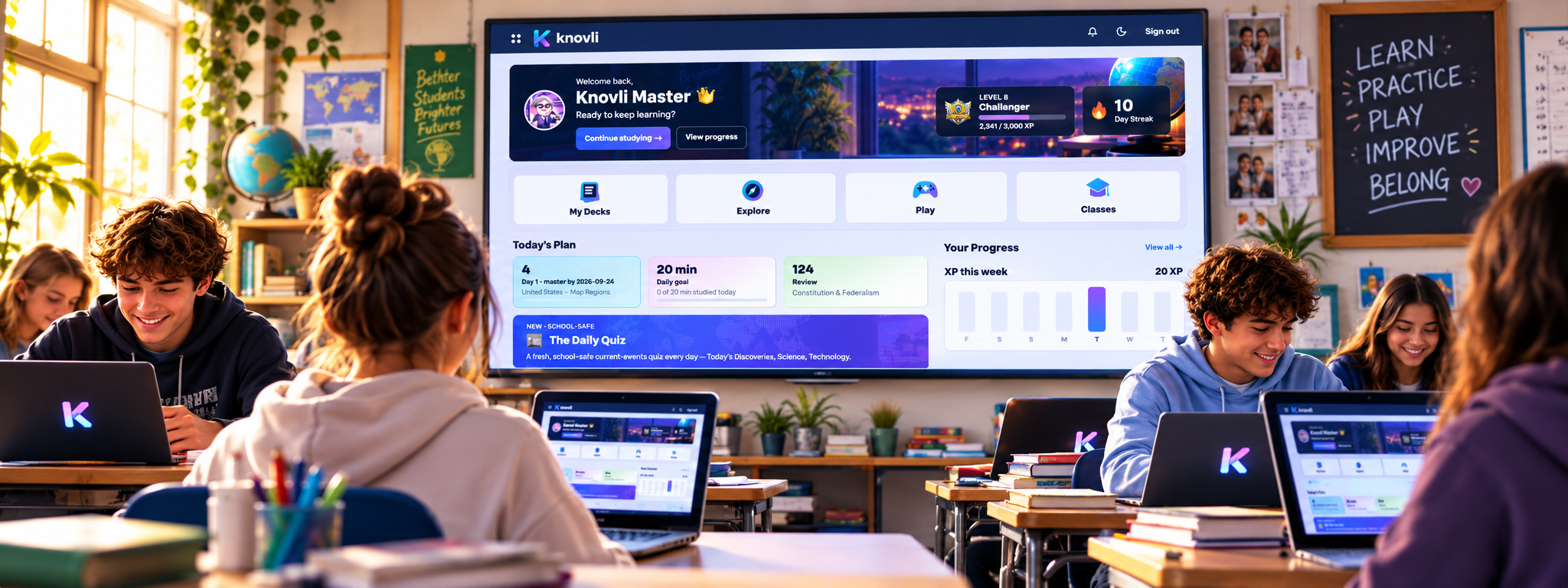
Learn how to use Knovli's free flashcard tools to cut lesson prep time, run classroom review activities, and improve student retention.
Why Flashcards Still Work — and Why Prep Time Matters
Decades of cognitive science back up what good teachers already know: retrieval practice beats re-reading. When students actively recall a fact, they retain it far longer than when they passively review notes. The problem is that building quality flashcard sets from scratch takes time teachers don't have.
Knovli solves both sides of that problem. The deck library gives you ready-made, curriculum-aligned sets you can use today, and the study modes do the pedagogical heavy lifting in class or at home.
Step 1: Find a Deck That Fits Your Lesson
Head to Explore and search by subject or course. You'll find decks covering a wide range of AP courses and geography. A few examples your students can use right now:
- U1: Constitution & Federalism — 124 cards for AP U.S. Government
- Civil Rights & Civil Liberties — 60 cards for AP U.S. Government
- Rhetorical Terms List — 51 cards for AP English Language and Composition
- 50 Key Terms for AP Lit — 53 cards for AP English Literature and Composition
- United States — Map Regions — 51 cards for World Geography
Once you find a deck, copy the link from your browser and share it directly with students via your LMS, email, or a QR code posted in the room.
Step 2: Use Study Modes to Run Classroom Activities
Knovli's study modes aren't just for solo homework. Here are three ways to use them during class time:
- Warm-up retrieval (5 minutes): Project a deck on your screen and call on students to answer before flipping the card. Works especially well with vocabulary or court cases.
- Partner quiz: Pair students and have one read the prompt while the other answers from memory. They swap roles after ten cards. No prep required beyond sharing the deck link.
- Exit ticket: At the end of class, students open the deck on their phones or laptops and complete a timed round independently. You see immediately who is struggling.
Step 3: Let Spaced Repetition Do the Long-Term Work
Cramming before a test produces short-term gains and long-term forgetting. Spaced repetition — reviewing material at increasing intervals — is the most evidence-backed method for durable retention. Encourage students to return to their decks two or three times a week rather than in one long session the night before a quiz.
A practical way to build the habit: assign a deck at the start of a unit and tell students to do one ten-minute session every other day. By the time the test arrives, the material is already consolidated.
Step 4: Make It Part of Your Routine, Not a Special Event
The teachers who see the biggest retention gains are the ones who make flashcard review a small, regular part of class — not an occasional activity. Three to five minutes at the start or end of a lesson adds up to hours of retrieval practice over a semester without eating into your instruction time.
You don't need to build anything new. With a library of ready-made decks at knovli.com/explore, the decks are already there. Share a link, open the room, and let the learning happen.
More Resources for Teachers
Visit the Knovli Teachers page for more ideas on integrating flashcards into your classroom practice.
Browse Knovli flashcard decks — free, no account needed to look.