Flashcards vs. Multiple Choice: When to Use Each Study Method

By Knovli · September 22, 2026
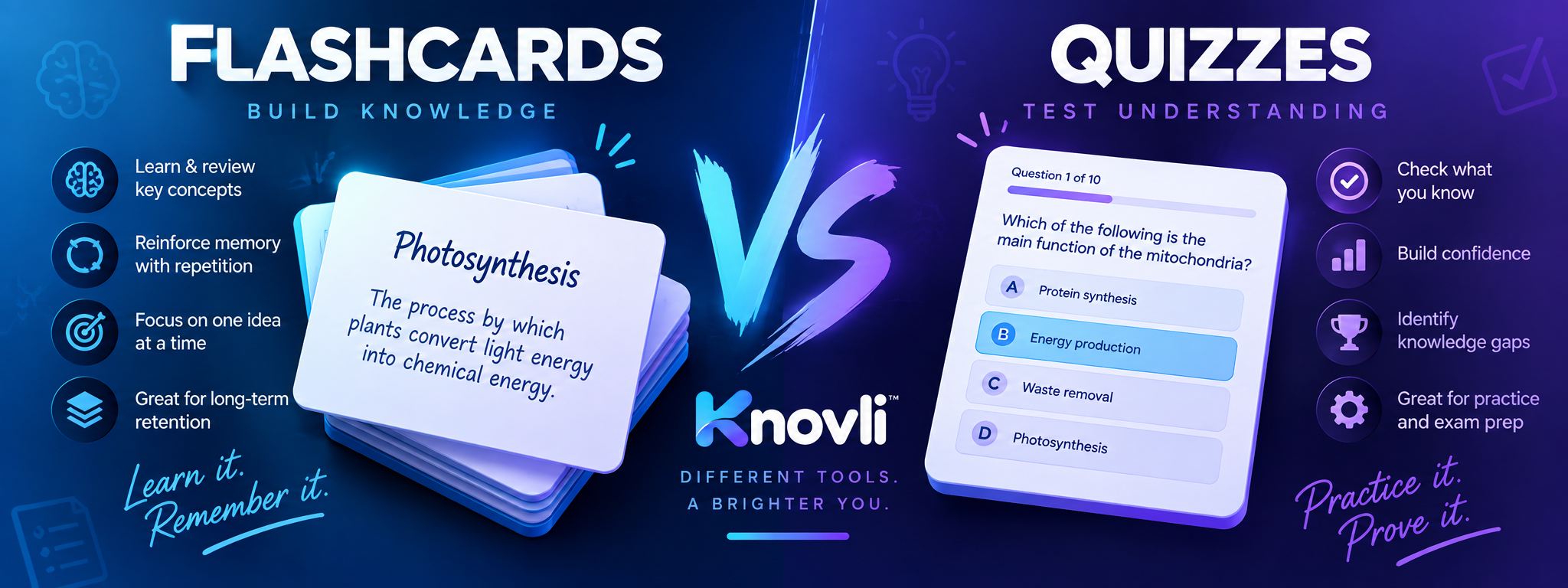
Flashcards build recall; multiple choice tests comprehension. Learn when to use each study method — and how to combine both for better exam results.
Two Tools, Two Jobs
Flashcards and multiple choice questions are both forms of retrieval practice — you pull information out of your memory rather than just reading it again. But they train different skills. Using the wrong one at the wrong time wastes study hours. Here is how to choose.
When Flashcards Win
Flashcards are the right tool when you need to know a fact, term, or concept on its own — no context, no options, just recall. That is harder than it sounds, and it is exactly what builds durable memory.
- Vocabulary and definitions. If you need to know what judicial review means without a hint, flashcards force that cold recall. A deck like U1: Constitution & Federalism [A.P. U.S. Government] is built for this — 124 terms you need to own, not recognize.
- Names, dates, and sequences. History courses demand that you retrieve facts in isolation before you can write about them. Working through U1 1491–1607: Contact and Settlement [A.P. U.S. History] with flashcards drills the raw material your essays depend on.
- Literary and rhetorical terms. Knowing 51 rhetorical devices cold — not just recognizing them — separates students who score well on AP English Language and Composition free-response questions from those who freeze. A deck like Rhetorical Terms List [A.P. English Language and Composition] targets exactly that.
- Early in a unit. When material is new, you need to build a mental map first. Flashcards let you tackle one concept at a time before you try to juggle relationships between them.
Concrete action: Start every new unit with a flashcard pass. Mark cards you miss and return to them the next day before adding new ones.
When Multiple Choice Wins
Multiple choice questions simulate the pressure of an actual exam and force a different cognitive skill: discrimination. You have to identify not just the right answer but why the other three are wrong. That is application, not just recall.
- Later in a unit. Once you know the terms, multiple choice reveals whether you really understand them. A question about federalism with four plausible-sounding answers tests comprehension in a way a flashcard cannot.
- Exam simulation. AP exams, SATs, and most standardized tests are multiple choice. Practicing under timed conditions builds the pacing and process-of-elimination habits that raise scores.
- Finding gaps you did not know you had. You can fool yourself with flashcards — if you hesitate but eventually remember, you might mark it correct. A multiple choice wrong answer is unambiguous. It tells you exactly where your understanding breaks down.
- Concepts with nuance. Some ideas are easy to misremember in a specific direction. Seeing a wrong answer that sounds right — and learning why it is wrong — corrects those misunderstandings faster than reviewing a card.
Concrete action: After two or three flashcard sessions on a topic, find or write five multiple choice questions. If you get any wrong, go back to the relevant flashcards and add a note about the distractor that fooled you.
How to Combine Both
The most effective study plans use flashcards and multiple choice in sequence, not as substitutes for each other.
- Week 1 of a unit: Flashcards daily. Focus on definitions and raw recall. Use spaced repetition — review missed cards sooner, known cards less often.
- Week 2: Introduce multiple choice. Use flashcards only for cards you are still missing. Let practice questions drive your review list.
- Final review: Multiple choice under timed conditions. Use flashcards only as a lookup tool when you miss a question and need to re-learn the underlying fact.
Knovli's study modes let you switch between recall and other formats using the same deck, so you do not have to build separate materials for each phase.
A Note for Teachers
Assigning a shared flashcard deck at the start of a unit and a multiple choice quiz at the end is a low-prep way to build both skills deliberately. Students who score poorly on the quiz can pinpoint which cards to revisit rather than re-reading the whole chapter. You can share decks with your class through Knovli for Teachers.
The Short Version
- Use flashcards when you need to build recall from scratch — new terms, definitions, isolated facts.
- Use multiple choice when you need to test comprehension, simulate an exam, or find hidden gaps.
- Use both in sequence — flashcards first, multiple choice to confirm you actually know it.
Browse Knovli flashcard decks — free, no account needed to look.