AP U.S. Government Unit 2: The Federal Government — Complete Study Guide

By Knovli · October 2, 2026
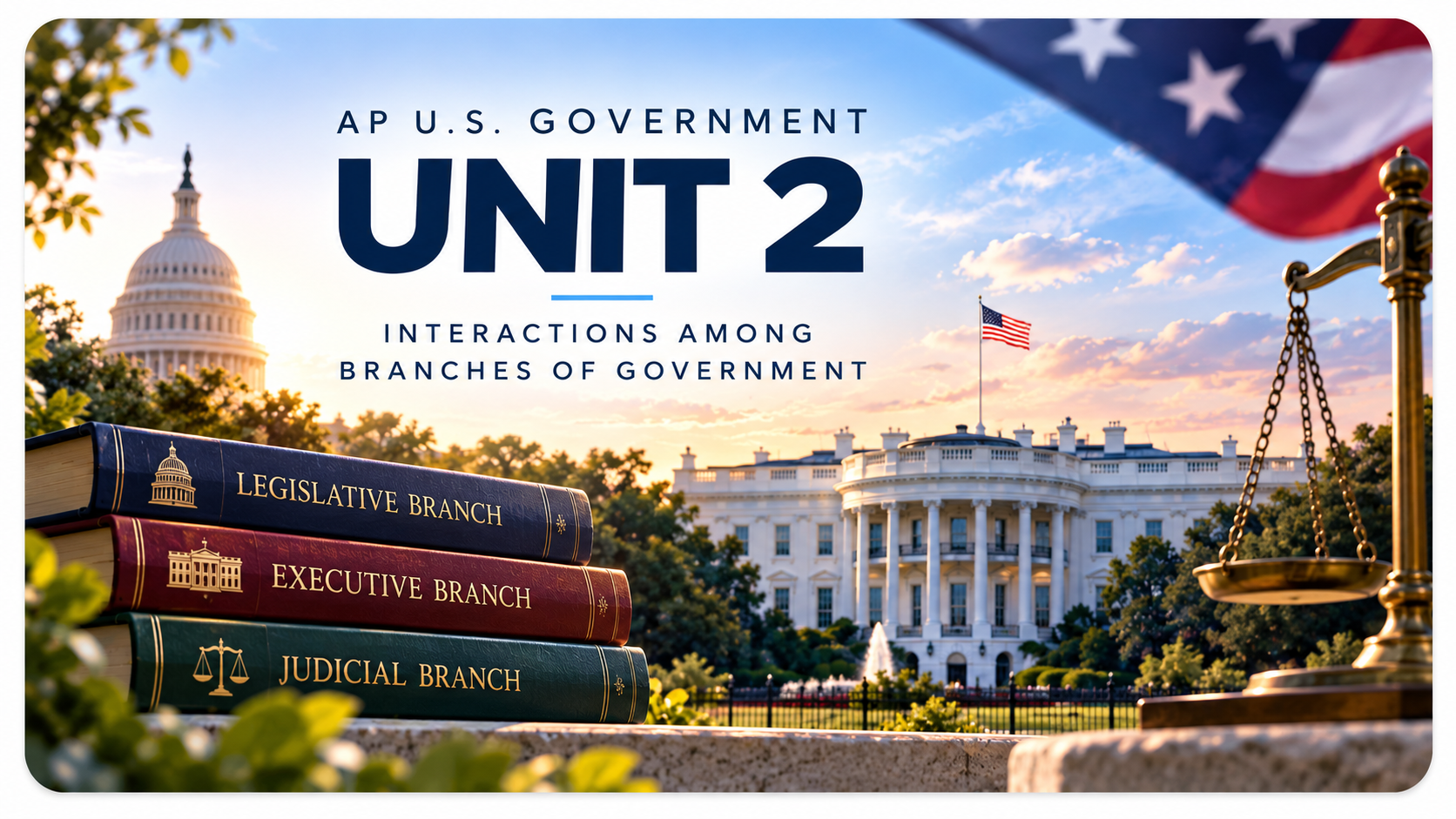
Complete AP U.S. Government Unit 2 study guide covering Congress, the President, the federal bureaucracy, and the courts — with FRQ tips and key vocab.
What Is Unit 2 About?
Unit 2 of AP U.S. Government and Politics covers the three branches of the federal government plus the federal bureaucracy. It is one of the largest and most tested units on the exam, making up a significant portion of both the multiple-choice and free-response sections. Understanding how Congress, the President, the courts, and the bureaucracy interact — and where they check each other — is essential for earning a high score.
Use the flashcard decks below alongside this guide. The U2: The Federal Government deck (135 cards) covers the full unit, while U2A: Congress (78 cards) and U2B: Executive, Judiciary, and Bureaucracy (71 cards) let you drill each branch separately.
Congress
Structure and Membership
Congress is bicameral, meaning it has two chambers with different compositions and rules.
- House of Representatives: 435 members apportioned by state population. Representatives serve 2-year terms and must be at least 25 years old. The House is considered more responsive to public opinion because members face voters frequently.
- Senate: 100 members, two per state regardless of population. Senators serve 6-year terms (staggered so roughly one-third face election every two years) and must be at least 30 years old. The Senate is designed to be a more deliberative, stable body.
Key Powers of Congress
- Article I powers include taxing, spending, declaring war, regulating commerce, and coining money.
- Necessary and Proper Clause (Elastic Clause): Allows Congress to make laws needed to carry out its enumerated powers. This is the constitutional basis for implied powers.
- Power of the purse: Congress controls the federal budget. This is one of the strongest checks Congress holds over both the executive and the bureaucracy.
- Oversight: Congress monitors executive agencies through hearings, investigations, and the confirmation process.
The Legislative Process
A bill can be introduced in either chamber (except revenue bills, which must start in the House). It is then referred to a committee, debated, amended, and voted on. If it passes both chambers in identical form, it goes to the President, who can sign it, veto it, or allow it to become law without signature. Congress can override a veto with a two-thirds majority in both chambers.
- Filibuster: A Senate tactic where a senator prolongs debate to delay or block a vote. Ending a filibuster requires a cloture vote of 60 senators.
- Reconciliation: A budget process that bypasses the filibuster and requires only a simple majority in the Senate.
- Conference committee: A temporary joint committee that resolves differences between House and Senate versions of a bill.
Congressional Committees
Most real legislative work happens in committees, not on the floor. Know these types:
- Standing committees: Permanent committees with jurisdiction over specific policy areas (e.g., Appropriations, Armed Services, Judiciary).
- Select/special committees: Temporary committees created for a specific purpose, often an investigation.
- Joint committees: Include members of both chambers, usually for administrative or research purposes.
- Conference committees: Resolve differences between House and Senate versions of a bill.
Factors That Influence Congressional Voting
- Party affiliation: The single strongest predictor of how a member votes.
- Constituents: Members represent their district or state and must weigh home-district opinion, especially in an election year.
- Interest groups and PACs: Provide campaign funding and information. Members who rely on certain industries often vote accordingly.
- The President: Can lobby members directly, especially those of the same party.
- Delegates vs. trustees: The delegate model says members should vote exactly as constituents want; the trustee model says members should use their own judgment for the broader good.
The Executive Branch
Presidential Powers
The President's powers are divided into formal (constitutional) and informal powers.
- Formal powers: Commander in chief of the military, veto legislation, grant pardons, negotiate treaties (with Senate ratification by two-thirds), appoint federal judges and Cabinet members (with Senate confirmation), deliver the State of the Union address, and call Congress into special session.
- Informal powers: Executive orders (directives with the force of law that do not require congressional approval), executive agreements (international agreements that bypass the Senate), signing statements (written declarations about how the President will interpret a law), and the bully pulpit (using public speeches and media to pressure Congress and shape opinion).
Presidential Roles
- Chief Executive — enforces federal law
- Commander in Chief — leads the military
- Chief Diplomat — conducts foreign policy
- Chief Legislator — proposes the agenda and signs or vetoes bills
- Head of State — ceremonial representative of the nation
- Party Leader — works to advance the agenda of the political party
Checks on Presidential Power
- Congress can override vetoes (two-thirds vote in both chambers).
- Senate must confirm appointments and ratify treaties.
- Congress controls the budget — the President proposes, but Congress disposes.
- The War Powers Resolution (1973) requires the President to notify Congress within 48 hours of deploying troops and limits deployments to 60 days without congressional authorization.
- Federal courts can rule executive actions unconstitutional.
- The House can impeach; the Senate tries and removes.
The Vice President and the Cabinet
The Vice President's main constitutional role is to preside over the Senate and cast tie-breaking votes. In practice, modern Vice Presidents serve as close advisors and political partners. The Cabinet consists of the heads of the 15 executive departments (e.g., State, Defense, Treasury). They are appointed by the President and confirmed by the Senate, and they advise the President and run their departments.
The Federal Bureaucracy
What the Bureaucracy Does
The federal bureaucracy is the collection of agencies, departments, and offices that implement and administer federal law on a day-to-day basis. Congress passes broad legislation; the bureaucracy fills in the details through a process called rule-making.
Types of Federal Agencies
- Cabinet departments: The 15 major departments (e.g., Department of Education, Department of Defense) headed by secretaries who report to the President.
- Independent regulatory agencies: Created by Congress to regulate specific sectors of the economy. They operate with some independence from the President (e.g., the Federal Reserve, the FCC, the SEC).
- Government corporations: Business-like agencies that charge for services (e.g., the U.S. Postal Service, Amtrak).
How Congress Controls the Bureaucracy
- Appropriations: Congress can cut or increase agency budgets.
- Oversight hearings: Committees can summon agency heads to testify.
- Legislation: Congress can rewrite an agency's authorizing statute to change its mission or limit its power.
- Senate confirmation: The Senate must approve top agency appointments.
Bureaucratic Drift and the Iron Triangle
Bureaucratic drift occurs when an agency's actions move away from what Congress intended, often because the agency develops its own culture, priorities, or relationships with outside groups.
The iron triangle describes the mutually beneficial relationship among a congressional committee, a federal agency, and an interest group. Each supplies what the others need: the committee provides funding and oversight, the agency provides favorable rules and implementation, and the interest group provides political support and information.
An issue network is a looser, more fluid version of this — a web of individuals and organizations (including think tanks, media, and academics) that all have an interest in a particular policy area.
The Federal Judiciary
Structure of the Federal Courts
- District courts: The trial courts of the federal system. There are 94 districts across the country. This is where cases are first heard.
- Courts of appeals (circuit courts): Hear appeals from the district courts. There are 13 circuits. They do not hold new trials — they review the record of the lower court and decide whether the law was applied correctly.
- Supreme Court: The highest court in the country. It has original jurisdiction in a small number of cases (e.g., disputes between states) and appellate jurisdiction over all other federal cases. It receives thousands of petitions each year but grants certiorari (agrees to hear a case) in only about 60–80.
Judicial Review
The power of federal courts to strike down laws or executive actions that violate the Constitution. This power is not explicitly stated in the Constitution — it was established in Marbury v. Madison (1803), one of the required Supreme Court cases for the exam.
Judicial Philosophy
- Judicial activism: Judges are willing to use the power of the courts to correct injustices or expand rights, even if it means overturning precedent or striking down legislation.
- Judicial restraint: Judges defer to the elected branches and existing precedent whenever possible. Courts should interpret the law, not make it.
- Originalism: The Constitution should be interpreted according to the original intent or original public meaning of the text at the time it was written.
- Living Constitution: The Constitution should be interpreted in light of contemporary values and evolving circumstances.
Factors That Shape Supreme Court Decisions
- The text of the Constitution and existing precedent (stare decisis)
- The ideological composition of the Court
- Public opinion (indirect influence)
- The Solicitor General's arguments when the federal government is a party
- Amicus curiae briefs from outside groups
Required Court Cases Relevant to Unit 2
Several of the AP required court cases involve the powers of the federal government. Practice them with the Required Court Cases deck (16 cards).
- Marbury v. Madison (1803): Established judicial review.
- McCulloch v. Maryland (1819): Upheld the Necessary and Proper Clause and the supremacy of federal law over state law.
- United States v. Lopez (1995): Limited congressional power under the Commerce Clause — Congress cannot regulate non-economic activity under that clause.
How the Branches Check Each Other: A Quick Reference
- Congress checks the President: Override vetoes, control spending, confirm appointments, ratify treaties, declare war, impeach and remove.
- Congress checks the courts: Confirm judges, propose constitutional amendments, create lower courts, adjust court jurisdiction.
- President checks Congress: Veto legislation, call special sessions, use the bully pulpit.
- President checks the courts: Nominate judges, pardon power.
- Courts check Congress: Strike down laws as unconstitutional (judicial review).
- Courts check the President: Strike down executive orders and agency actions as unconstitutional or illegal.
FRQ Tips for Unit 2
Unit 2 is heavily tested in the free-response section. Here is what to keep in mind:
- Know the difference between formal and informal powers. FRQs often ask you to explain how a President can accomplish a goal — be specific about whether the tool requires congressional action or not.
- Use precise vocabulary. Words like cloture, filibuster, executive order, judicial review, and iron triangle signal to scorers that you understand the concept, not just the general idea.
- Connect branches to each other. The exam loves questions about how one branch limits or responds to another. Practice writing sentences like: "Congress can check presidential power by ____ because ____".
- Required documents matter here too. Federalist No. 70 (Hamilton's argument for a strong executive) and Federalist No. 78 (Hamilton on an independent judiciary) are directly relevant to Unit 2. Review them with the Required Foundational Documents deck (10 cards).
- Bureaucracy FRQs are underestimated. Students often skip the bureaucracy section and are caught off guard. Know the iron triangle, rule-making, and the tools Congress uses to control agencies.
Recommended Flashcard Decks for Unit 2
- U2: The Federal Government — 135 cards covering the full unit
- The Federal Government — an alternate 135-card deck on the same material
- U2A: Congress — 78 cards focused on the legislative branch
- U2B: Executive, Judiciary, and Bureaucracy — 71 cards for the other three branches
- Required Court Cases — 16 cards on the cases tested on the exam
- Required Foundational Documents — 10 cards on the primary sources the exam requires you to know
Browse Knovli flashcard decks — free, no account needed to look.